Facebook
 Google
 GitHub
 Linkedin
Eaton and ChargePoint Join To Advance EV Charging Infrastructure
The two companies spoke to EEPower about their new collaboration and the fast-changing state of EV charging.
Electric vehicle charging infrastructure is expanding, and Eaton and ChargePoint aim to be at the forefront of developing it. The companies have formed a partnership to simplify EV charger deployment and advance bidirectional and vehicle-to-everything technologies throughout North America and Europe.
The collaboration combines ChargePoint’s EV charging solutions with Eaton’s expertise in energy management, a synergy the companies hope will help promote electrification efforts, increase reliability, and decrease costs.
EEPower spoke with Paul Ryan, general manager of energy transition at Eaton, and Rick Wilmer, president, board member, and CEO of ChargePoint, to learn more about their vision of EV charging infrastructure.
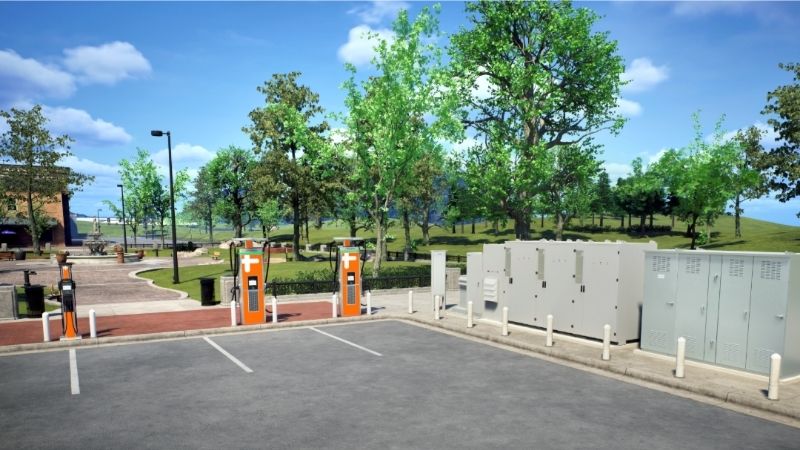
Rendering of EV charging infrastructure from Eaton and ChargePoint. Image used courtesy of Eaton
Who’s Charging EVs, and Where?
Most EV charging happens in the driver’s home, but two other locations are growing in popularity: commercial buildings and fleet operations, according to Wilmer.
Business owners are installing EV charging stations to make their locations more valuable to employees or patrons. These locations include retail, such as restaurants and shopping malls, and non-retail, like schools, libraries, and office buildings.
“Retailers are now understanding that providing this new value to their constituents can get them to come to their place, as opposed to the competitor’s place,” Wilmer said. “Maybe stay longer, maybe spend more, etc.”
While EV chargers in these locales are not “mission-critical to the business,” adding EV charging helps the business do more for the people they care about.
The second growing market is fleet operations. More businesses are electrifying their fleets and need cost-efficient charging solutions. In this case, a reliable charging system is truly mission-critical, Wilmer said.
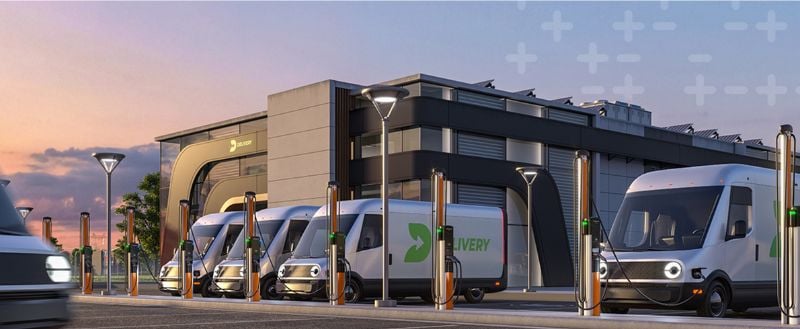
Fleet charging. Image used courtesy of ChargePoint
“If your fleet vehicles don’t get out or run their routes every day or deliver the kids to school or take the packages to the houses, you’re impacting your business,” he explained.
Powering EV Charging
Insufficient electrical infrastructure is a common obstacle people face when installing charging stations. Adding EV charging can overburden the system.
“Residential homes, commercial buildings, fleets—those buildings were not originally designed to be able to deal with this much power,” Ryan explained. “There’s a significant amount of homes in North America that do not have a big enough service supply to be able to electrify their homes and charge a vehicle. Same with commercial buildings and fleet applications.”
Building owners can either upgrade their service or implement intelligent energy management. This is especially needed as they make other moves toward electrification, such as adding solar and energy storage or electrifying building systems. Adding intelligent energy management makes the existing system “work smarter and harder,” Ryan said.
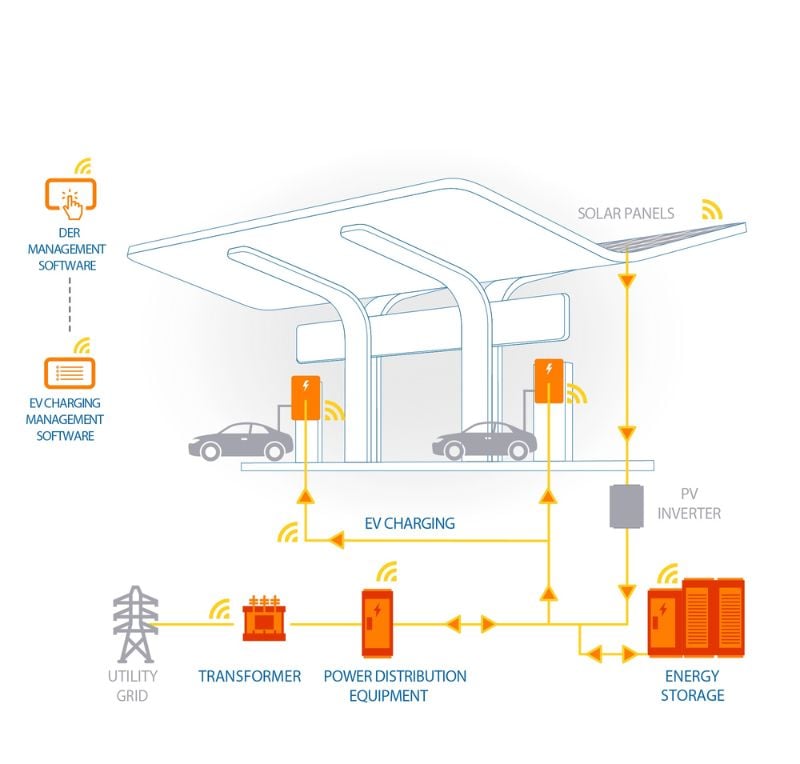
Managed EV charging, working with onsite solar and storage. Image used courtesy of Eaton
Bidirectional Benefits
The two companies will also team up to further develop bidirectional charging and encourage its use. Wilmer and Ryan outlined several benefits for charger owners and electrical systems. Electric vehicles can be assets to power homes and buildings, and can work with onsite solar and battery storage systems to provide and access energy when needed or rates are lowest.
Bidirectional charging can also optimize fleet operations, Wilmer pointed out, using an example of a delivery service with a 50-van fleet.
“All those 50 vehicles, they may leave at different times of the morning, or they may go different distances, so they may not all need 100% of the vehicle’s state of charge to drive their route,” he explained. “So now I charge them intelligently. I charge Vehicle 1 first to a 50% state of charge because it’s first but runs a shorter route. Then Vehicle 2 charges second, and it gets a 100% state of charge because it goes out much longer.”
As the vehicles return from their routes, any excess charge can benefit the other vehicles.
“When Vehicle 9 comes back with some energy left in the battery, and Vehicle 10 needs more energy to finish its day, you move some energy from Vehicle 9 to Vehicle 10,” Wilmer said. “The ability to move the energy around to where it’s needed allows you to do more with less.”
What About DC Fast Charging?
While DC fast charging is making headlines with promises of shorter charging times and longer driving range, it’s not necessarily the optimal choice for most charging infrastructure, Wilmer said.
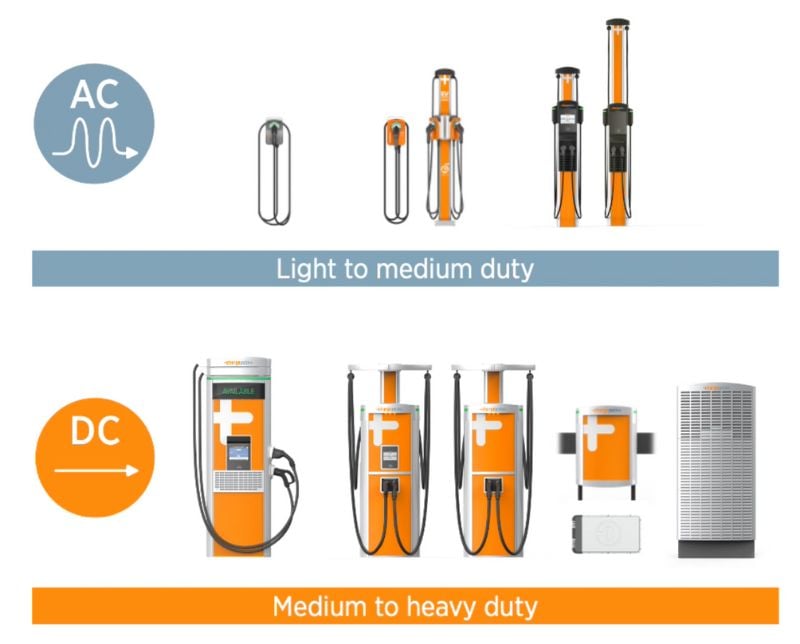
ChargePoint’s portfolio includes both AC and DC fast chargers. Image used courtesy of ChargePoint
“Having the DC fast chargers available on the major highways throughout the country is really important for EV adoption, but if you look at the amount of total energy put into EVs from DC fast chargers, it’s tiny compared to the amount of energy that you will put into EVs at your home or at your workplace, which are by far the most common places to charge,” Wilmer said.
Still, fast charging does have a place in the total infrastructure. “There are companies out there building DC fast-charging networks,” Wilmer said. “Their business is to make money selling electricity, like a gas station makes money selling gas. So if you can reduce the cost of the infrastructure, the fuel pumps, essentially, to provide that electric fuel, you help their business model.”
”Whether it’s conventional charging or fast charging, the goal is to optimize the charging system, Ryan added. “Through our technical integration, we’re going to be focusing on, how can we give a more reliable charging experience, and how can we reduce the total costs? How can we make the footprint smaller? How can we make it easier to install?”